
Updated Sep. 1, 2026: CHAI and its partners have developed a FAQ document to aid stakeholders in understanding the details of the products, the agreement terms, and the potential benefits for TB programs. See the FAQ here
New agreements with DeepTek and Delft Imaging cut annual software costs by up to 65 percent.
Unitaid and the Clinton Health Access Initiative (CHAI) today announced new agreements with two leading providers of AI-powered TB screening software, DeepTek and Delft Imaging, that will dramatically reduce the cost of computer-aided detection (CAD) software for tuberculosis (TB) programs in low- and middle-income countries, cutting costs by up to 65 percent through an all-inclusive annual fee for unlimited use per connected x-ray device.
TB remains the world’s deadliest infectious disease, and chest X-rays are a critical screening tool to ensure people get access to life-saving care. However, in many countries that bear the greatest TB burden, the ability to offer and interpret chest-X-rays is limited by many factors, including a severe shortage of radiologists—in some settings, as few as one per million people. Without specialists to read images, screening programs stall, and people can go undetected for months, spreading disease silently through communities.
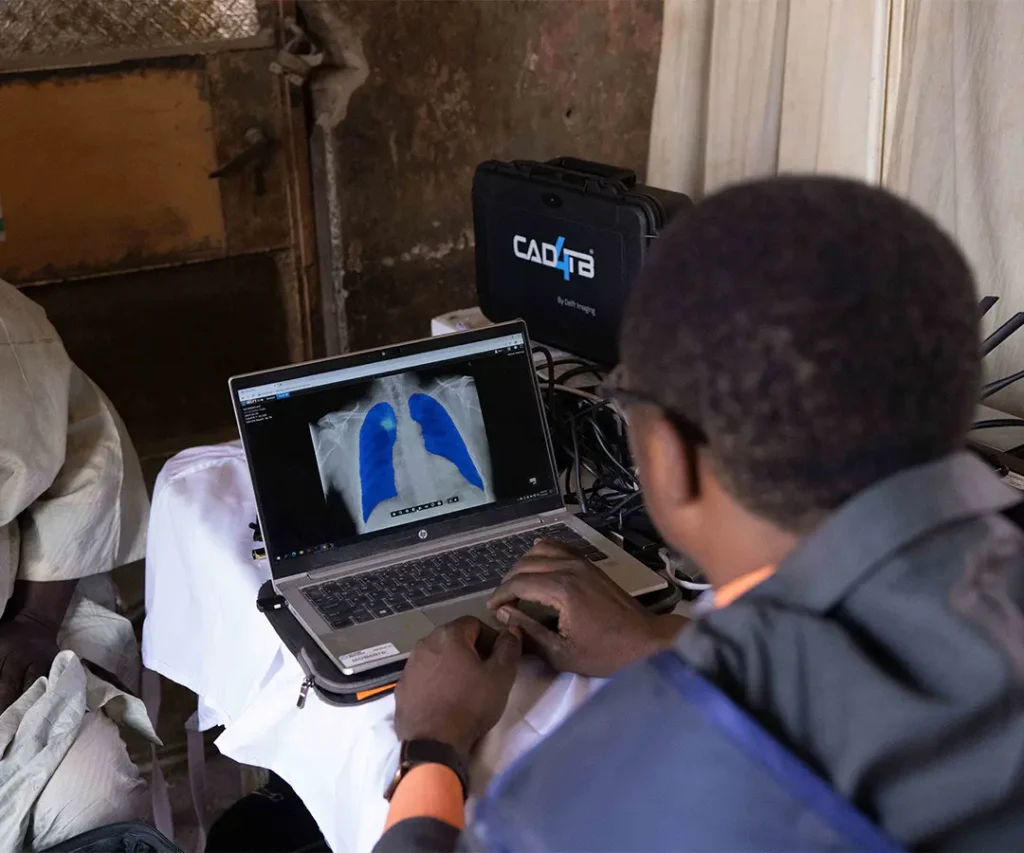
CAD software uses artificial intelligence (AI) to read chest X-ray images and flag signs of TB, performing on par with a trained radiologist. This removes a critical bottleneck: a chest X-ray taken in a village or mobile clinic can be analyzed instantly, enabling people to get screening results the same day. Until now, however, many programs have faced tens of thousands of dollars in upfront costs for software licenses, computing hardware, installation, training and warranty extensions.
Recent donor funding disruptions and the expiry of many previously purchased access licenses have made that cost increasingly unsustainable. Many programs that scaled screening over the last several years now face renewal or warranty extensions at prices their domestic budgets cannot absorb. The new pricing model helps address this challenge through a single, transparent annual fee of $2,500-$2,850 per X-ray unit, down from US$7,000 to US$12,000 per unit, per year. The license allows unlimited CAD scans per unit, and covers software, installation and training, software updates, and maintenance with no hidden add-on costs. The agreements also set transparent pricing for additional indications that can use the same software, such as cardiomegaly, silicosis, and lung cancer, to enable use of CAD as a broader chest x-ray interpretation tool.
Combined with the reduction in the price of portable X-ray devices negotiated by Unitaid and CHAI in 2025, today’s announcement means programs can now deploy a complete AI-powered TB screening solution, X-ray and CAD software together, at a fraction of the previous cost. For countries facing the largest TB burdens, that changes what’s possible at scale.
“TB is curable, but only if you catch it. Today, millions of people go undiagnosed simply because there is no expert around to read their X-ray,” said Dr. Neil Buddy Shah, CEO of CHAI. “AI-powered software can now do that in seconds, and this agreement makes it far more affordable, dramatically increasing the number of people who can be diagnosed and put on treatment.”
“By reducing the cost of AI interpretation software by up to 65%, these agreements demonstrate how market shaping can make proven innovations more accessible,” said Dr. Philippe Duneton, Executive Director at Unitaid. “At a time when funding constraints are threatening progress in TB detection, lowering the cost of these tools is critical to helping countries expand access to timely TB diagnosis and care, and make a difference for millions of people.”
The agreements cover public sector and not-for-profit buyers across all 138 World Bank-defined low-, lower-middle-, and upper-middle-income countries. Both DeepTek’s and Delft’s CAD products will be available with immediate effect directly from the suppliers.
To aid stakeholders in understanding the details of the products, the agreement terms, and the potential benefits for TB programs, CHAI and its partners have developed a “Frequently Asked Questions” guide.
Notes to editors
About computer-aided detection for TB: CAD software interprets chest radiograph images using artificial intelligence to identify abnormalities consistent with pulmonary TB, producing an abnormality score that indicates the likelihood TB is present. The World Health Organization (WHO) recommends CAD for TB screening and triage in individuals 15 and older, and in 2025 identified six products meeting its performance standards, including CAD4TB from Delft Imaging and Genki from DeepTek. The field is rapidly evolving; neither agreement restricts use in age groups where products gain regulatory approval, and both suppliers have committed to future pediatric access at no additional cost. Unitaid and partners are also exploring the use of CAD software for TB screening in children, where evidence is still emerging.
About the agreements: The agreements offer both one-year access (US$2,500-US$2,850 per connected X-ray unit) and a three-year term (US$7,500 per connected X-ray unit), giving programs flexibility to align procurement with their funding cycles.
About CHAI: The Clinton Health Access Initiative, Inc. (CHAI) is a global health organization committed to saving lives and reducing the burden of disease in low- and middle-income countries while strengthening the capabilities of governments and the private sector in those countries. For more information, visit www.clintonhealthaccess.org.
About Unitaid: Unitaid is a global health organization that saves lives by making critical health products available and affordable for people in low- and middle-income countries. Unitaid is hosted by the World Health Organization. For more information, visit www.unitaid.org
About ASCENT: The agreements were developed under the ASCENT DR-TB Market Access Partnership, a Unitaid-funded initiative led by KNCV Tuberculosis Foundation with CHAI and the Aurum Institute as market access partners. ASCENT supports countries to accelerate adoption of effective TB treatment regimens and shapes markets to ensure global affordability of WHO-recommended TB commodities. For more information, visit www.ascentdrtb.org
DeepTek: DeepTek is a global leader in AI-powered radiology, with deployments across more than 2,000 healthcare sites worldwide and touching one patient every five seconds. Its AI-powered Chest X-ray solution detects 20+ abnormalities, including tuberculosis (TB), and is US FDA-cleared, CE-marked, and recommended by the WHO for TB screening. Trusted by national TB programs, governments, and global health organizations, DeepTek is enabling large-scale lung health screening across LMICs by supporting earlier disease detection, reducing diagnostic delays, and expanding access to high-quality diagnostic services. For more information, visit www.DeepTek.ai
About Delft: Delft Imaging develops and delivers diagnostic imaging solutions tailored to strengthen health systems in vulnerable and resource-constrained settings. Since 2002, the organization has supported healthcare programs with AI-enabled screening, digital X-ray, mobile clinics, point-of-care ultrasound, capacity building, and long-term service and support to improve patient outcomes across lung health and maternal health. To date, Delft Imaging solutions have supported screening for 55 million people across 90+ countries, with 3,000+ installations deployed and 4,300+ health professionals trained. For more information, visit www.delftimaging.com